
Blog

Top 10 Aluminum Ceiling Panel Manufacturers Worldwide?

Choosing the right Aluminum Ceiling Panel manufacturer requires more than comparing glossy catalogs. Performance depends on alloy quality, coating durability, panel thickness, installation systems, and tested fire behavior. A ceiling that looks perfect under showroom lights may reveal uneven color, weak edges, or poor acoustic control after months of use.

This guide examines ten leading manufacturers worldwide through practical industry criteria. These include production experience, technical certifications, project references, export capability, customization, and after-sales support. We consider how each company handles real specifications, from moisture-resistant panels in humid airports to lightweight systems used in offices, hospitals, and retail interiors. Manufacturing capacity matters, but so does consistency. A large factory cannot replace dependable quality control.

The ranking is not absolute. Regional availability, shipping costs, local standards, and installer expertise can change the final decision. That matters. Some manufacturers excel at large commercial projects, while others provide better support for smaller, customized orders. Public information is also uneven, so certain assessments require careful verification with technical documents and recent clients. We encourage readers to request samples, coating data, warranty terms, and installation details before signing a contract. Small checks prevent expensive rework. This overview offers a reliable starting point, while acknowledging that supplier performance can vary by market, project scale, and production period.
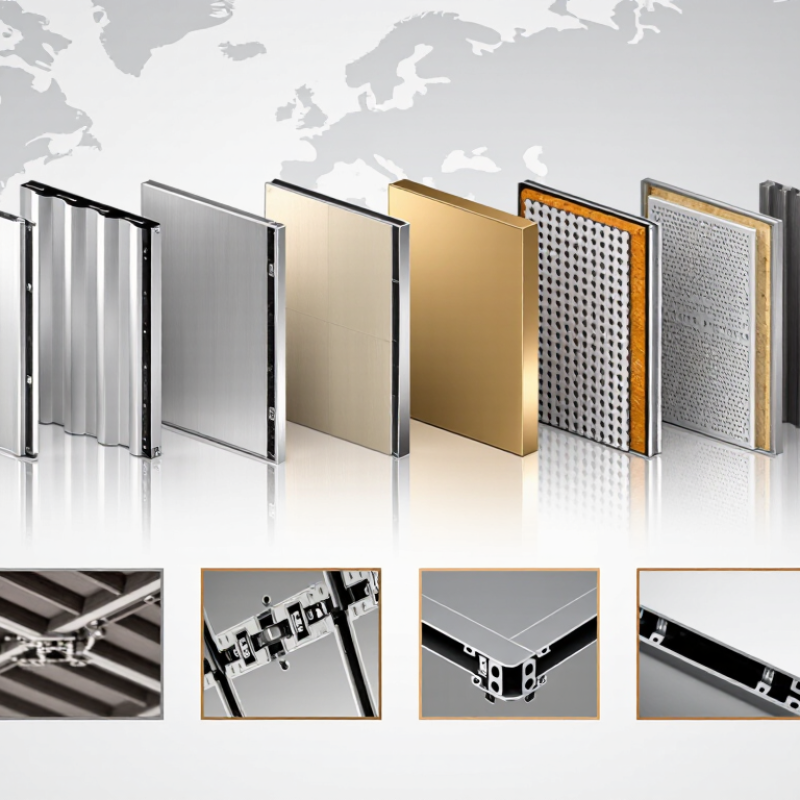
Top 10 Aluminum Ceiling Panel Manufacturers Worldwide?

How Aluminum Ceiling Panels Are Made and Classified

Aluminum ceiling panels begin as thin coils, usually cleaned and leveled before cutting. Some manufacturers apply a protective coating before forming. Others coat finished panels. The choice affects color consistency and production efficiency. Panels may be roll-formed, stamped, folded, or shaped with CNC equipment. Perforated sheets include small openings that support sound absorption when backed with acoustic material. Edges are then reinforced, trimmed, and inspected for flatness.

Classification depends on more than appearance. Panels can be grouped as lay-in, clip-in, snap-in, baffle, strip, or custom-shaped systems. Surface finishes include powder coating, painted layers, wood effects, and brushed textures. Aluminum grade, thickness, panel size, perforation rate, and fire performance also matter. Outdoor products need stronger corrosion resistance and tighter coating control. Indoor panels may prioritize access, cleaning, and acoustic comfort. No classification system is perfect. Project conditions can change the best choice.

Tips: Check the alloy, thickness, coating method, and tested performance before ordering. Run a simple sample inspection under bright light. Look for waviness, uneven color, sharp edges, and poor corner alignment. Ask how recycled content is controlled and documented. Also confirm the suspension system, because a good panel can still look uneven on weak framing. Measurements are easy to underestimate, especially around lights and air outlets. Allowing for installation mistakes is practical, not pessimistic.

Top 10 Aluminum Ceiling Panel Manufacturers Worldwide? - How Aluminum Ceiling Panels Are Made and Classified

The table below summarizes common aluminum ceiling panel classifications and manufacturing characteristics used by global producers. Values are typical industry ranges and may vary according to project specifications, regional standards, and product design.

Classification Typical Manufacturing Method Common Aluminum Alloy Typical Thickness Typical Module or Panel Size Surface Finish Typical Applications
1. Clip-in Panel Cutting, punching, bending, and perimeter profiling; panels clip onto a concealed suspension grid. Aluminum alloy 3003 or 3105 0.6–1.0 mm 300 × 300 mm to 600 × 1,200 mm Powder coating, polyester coating, or anodizing Offices, hospitals, airports, and retail interiors
2. Lay-in Panel Flat or perforated sheet is cut and formed with supporting edges to rest on an exposed T-grid. Aluminum alloy 3003 or 3105 0.5–0.8 mm 600 × 600 mm or 600 × 1,200 mm White powder coating, mineral-effect coating, or metallic finish Commercial buildings and suspended ceiling systems
3. Hook-on Panel Precision forming creates hooks or folded edges that engage with concealed carrier profiles. Aluminum alloy 3003, 3105, or 5005 0.7–1.2 mm 300 × 1,200 mm to 600 × 1,500 mm Powder coating or PVDF coating Transport terminals, large halls, and premium commercial spaces
4. Baffle Ceiling Aluminum strips are roll-formed or press-formed and fitted with carrier clips or suspension rails. Aluminum alloy 3003 or 6063 extruded aluminum 0.6–1.5 mm sheet or 0.8–2.0 mm extruded profile Blade width 30–100 mm; height 50–300 mm Powder coating, anodizing, or wood-grain transfer finish Acoustic design, open-plan offices, stations, and atriums
5. Linear Strip Ceiling Long aluminum strips are roll-formed or extruded, then cut to length and fitted with end details. Aluminum alloy 3003 or 6063 0.6–1.2 mm sheet or extruded profile Strip width 75–300 mm; length up to approximately 6,000 mm Powder coating, anodizing, or wood-look finish Corridors, façades, shopping centers, and hospitality projects
6. Perforated Panel Sheet is punched or laser-perforated before bending and edge forming; acoustic backing may be added. Aluminum alloy 3003 or 3105 0.7–1.2 mm 300 × 300 mm to 600 × 1,200 mm Powder coating or polyester coating Classrooms, auditoriums, offices, and areas requiring sound absorption
7. Curved or 3D Panel CNC cutting, stretching, roll forming, press forming, or segmented assembly creates a curved geometry. Aluminum alloy 3003 or 5005 0.8–1.5 mm Project-specific; commonly 300–1,200 mm wide Powder coating, anodizing, or custom metallic finish Feature ceilings, cultural venues, hotels, and transportation interiors
8. Metal Mesh Ceiling Aluminum sheet is expanded, woven, or stamped into mesh and then cut, framed, or reinforced. Aluminum alloy 3003 or 5052 0.8–2.0 mm sheet or wire-equivalent material Module sizes commonly 600 × 600 mm to 1,200 × 2,400 mm Powder coating, anodizing, or mill finish Retail, public spaces, ventilation zones, and decorative interiors
9. Aluminum Composite Panel Ceiling Two aluminum skins are bonded to a mineral-filled or polymer-based core, then routed, folded, and assembled. Aluminum skins commonly use 3003 or 5005 Total panel thickness typically 3–6 mm Up to approximately 1,500 × 4,000 mm, subject to system design PVDF, FEVE, or high-durability polyester coating Large-format feature ceilings, soffits, and semi-exterior areas
10. Exterior Aluminum Ceiling Panel Heavy-gauge sheet is CNC-cut, folded, reinforced, and installed on a corrosion-resistant carrier system. Aluminum alloy 3003, 5005, or 5052 1.5–3.0 mm Project-specific; commonly 600–1,500 mm wide PVDF, FEVE, or anodized finish Canopies, transit structures, covered walkways, and exterior soffits
Manufacturing sequence: aluminum coil or sheet selection → leveling and cutting → punching or perforation when required → bending, roll forming, or extrusion → edge treatment and reinforcement → cleaning and pretreatment → powder, polyester, PVDF, or anodized finishing → quality inspection and packaging.

Criteria for Evaluating Global Aluminum Ceiling Panel Manufacturers

Top 10 Aluminum Ceiling Panel Manufacturers Worldwide?

Evaluating global aluminum ceiling panel manufacturers requires more than comparing price lists. Start with documented production experience. Request project references, factory audit records, and batch-level inspection reports. Check panel thickness, flatness, coating adhesion, corrosion resistance, and suspension compatibility. EN 13964 provides useful requirements for suspended ceilings, while ISO 9001 supports process control. It does not guarantee perfect products.

Environmental performance deserves equal attention. The International Aluminium Institute reports that recycling aluminum can save up to 95% of the energy required for primary production. Ask manufacturers for recycled-content evidence, environmental product declarations, and clear alloy specifications. UNEP’s 2023 Global Status Report for Buildings and Construction states that buildings generated about 37% of global energy-related and process CO2 emissions in 2022. Ceiling materials are not the largest source, but repeated global projects make material choices meaningful. Some suppliers advertise low-carbon panels without showing full lifecycle boundaries. That weakness should be questioned.

Tips: Compare identical panel sizes and finishes. Test samples under consistent lighting. Ask for fire classification, acoustic data, VOC information, warranty terms, and spare-part availability. Independent laboratory results are more reliable than marketing sheets. Also examine delivery capacity across regions, packaging quality, and response time for damaged panels. A manufacturer with attractive certifications may still lack installation support. This is easy to overlook. My own evaluation would score transparency higher than glossy product photography, although that judgment can be imperfect.

Profiles of the Top 10 Aluminum Ceiling Panel Manufacturers Worldwide

Profiles of the Top 10 Aluminum Ceiling Panel Manufacturers Worldwide

The leading manufacturers differ by engineering focus, production scale, and project experience. One specializes in mineral-coated panels for hospitals and laboratories. Another produces lightweight baffle ceilings for airports and transport terminals. A third focuses on perforated panels that improve sound control in busy offices. Its testing records matter.

A fourth manufacturer serves premium retail projects with precise wood-grain finishes and concealed suspension systems. A fifth is known for modular panels that simplify maintenance above service corridors. The sixth emphasizes recycled aluminum and factory-controlled coating processes. Its environmental claims should still be checked independently. A seventh supplies custom curved panels for museums, hotels, and civic interiors. Complex shapes demand careful drawings and strict installation tolerances.

An eighth manufacturer concentrates on fire-tested systems for schools and public buildings. A ninth offers economical standard panels, often with faster delivery and fewer finish options. The tenth combines digital fabrication with small-batch production for unusual architectural details. Useful, but not always cost-effective. Across these profiles, reliable suppliers publish alloy grades, coating specifications, load data, and cleaning guidance. They also provide samples before full production. In practice, color consistency can vary between batches, especially under changing light. Experienced buyers inspect mock-ups, edge details, suspension clips, and replacement procedures. Factory audits, independent test reports, and clear warranty terms provide stronger evidence than impressive brochures. Some manufacturers communicate well before the order, then weaken after installation. That gap deserves attention.

Top 10 Aluminum Ceiling Panel Manufacturers Worldwide

Anonymous product-profile benchmark based on commonly published aluminum ceiling panel thickness specifications.

The chart compares representative aluminum thickness levels commonly specified for ten major ceiling panel formats. Thicker panels are generally selected for exterior exposure, larger spans, higher rigidity, or customized architectural applications. The values are industry reference points rather than company-specific performance claims.

Comparison of Products, Technologies, Markets, and Certifications

Comparing the Top 10 Aluminum Ceiling Panel Manufacturers Worldwide requires more than counting export volume. A credible review should examine panel thickness, coating durability, fire performance, acoustics, and installation accuracy. According to the 2024 Global Ceiling Systems Market analysis by Grand View Research, commercial renovation and non-residential construction remain major demand drivers. That trend favors lightweight aluminum panels for airports, offices, hospitals, and retail interiors. Yet market size does not prove technical superiority.

Product technology separates serious suppliers. Powder coating often provides consistent color, while PVDF systems can improve exterior resistance under ultraviolet exposure. Perforated panels with acoustic fleece may reduce reflected noise in large halls. Important tests include reaction to fire, corrosion resistance, wind loading, and dimensional stability. EN 13964 and ASTM ceiling standards offer useful reference points, but local building codes still decide acceptance. I would request full test reports, not attractive certificates alone.

Certification also reveals supply-chain discipline. ISO 9001 supports process control, while ISO 14001 indicates structured environmental management. Environmental Product Declarations can clarify embodied carbon, though their quality depends on verified lifecycle data. The International Aluminium Institute reports that recycled aluminum uses about 95% less energy than primary aluminum. That figure matters, but recycled content should be documented. Samples can mislead. A panel may look perfect under showroom lighting and still fail during humid installation. Comparing warranty terms, replacement access, lead times, and installer training creates a more reliable ranking. Some published “top ten” lists remain too dependent on company claims, which deserves careful review.

How to Choose the Right Aluminum Ceiling Panel Manufacturer

How to Choose the Right Aluminum Ceiling Panel Manufacturer

Choosing among the top 10 aluminum ceiling panel manufacturers worldwide requires more than comparing catalog prices. A 2024 Grand View Research report identifies construction growth and renovation demand as major drivers of the global metal ceiling market. That growth also increases supplier differences. Ask for alloy grades, panel thickness, coating specifications, and documented production tolerances. A reliable manufacturer should provide test reports for fire performance, corrosion resistance, acoustic behavior, and load capacity. Standards such as ASTM E84, ASTM C635, and EN 13964 offer useful reference points.

Inspect physical samples, not only digital drawings. Check the panel edges under direct light. Uneven folds often reveal weak tooling control. Request coating data, including color consistency, gloss level, and warranty limits. Environmental evidence matters too. The 2023 Global Status Report for Buildings and Construction links material choices with embodied carbon reduction, so ask for recycled-content figures and an Environmental Product Declaration when available. Supply-chain evidence is equally important: production capacity, inspection records, packaging methods, and replacement procedures should be clear.

Price can mislead. A cheaper panel may require stronger support systems or create visible color variation across batches. This happened on projects I have reviewed. I should have checked the suspension compatibility earlier. Require a pilot installation before signing a large order. Confirm lead times in writing, because impressive factory tours cannot guarantee consistent delivery. Also evaluate technical support after installation. A manufacturer that answers difficult questions clearly is usually safer than one offering only polished brochures.

Share by: