
Choosing the right supplier for Black Barn Door Hardware requires more than comparing glossy product photos. Hardware must feel solid, move quietly, and remain reliable after repeated daily use. A black finish may look identical online, yet its durability can vary significantly.
This guide examines ten notable suppliers serving customers worldwide. It considers product range, steel or aluminum construction, coating quality, weight capacity, installation guidance, and replacement-part availability. These details matter when a barn door weighs over 100 pounds or slides across an uneven wall. Practical experience shows that a smooth roller is only part of the installation. Track alignment, wall support, and compatible door thickness often determine the final result.
We also consider manufacturing transparency, testing information, international shipping, response times, and customer feedback. Suppliers with clear specifications are easier to trust. Strong warranties help, but they cannot replace careful engineering. Some companies offer attractive prices while providing limited instructions. That weakness deserves attention.
Not every supplier excels in every category. One may provide excellent commercial hardware but slow delivery. Another may offer elegant finishes but fewer customization options. This comparison recognizes those trade-offs rather than presenting an unrealistic winner. Prices, availability, and service policies can change by region and season. Readers should verify current information before placing an order.
The goal is practical guidance for homeowners, designers, contractors, and retailers. Whether the project involves a compact pantry door or a wide rustic entrance, the right supplier can improve safety, appearance, and long-term performance. The final choice should match the door, wall structure, budget, and expected use. Looks matter. Reliability matters more.
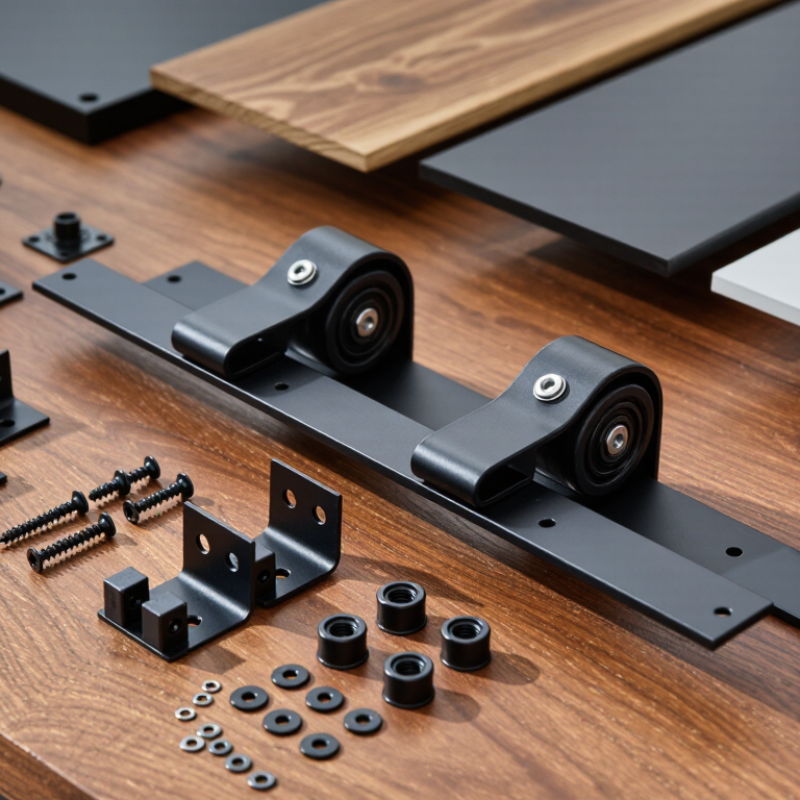
Top 10 Black Barn Door Hardware Suppliers Worldwide?
The global barn door category sits within a wider door hardware market. Fortune Business Insights valued this market at about USD 18.5 billion in 2024. Its report forecasts continued growth through 2032, supported by renovation and new construction. Black hardware benefits from this trend, but published data rarely separates black finishes from other colors. That limitation matters.
A serious global comparison should examine product types, not only supplier rankings. Common options include top-mount rollers, face-mount straps, bypass systems, soft-close kits, floor guides, pulls, and privacy locks. Steel remains common because it handles repeated movement. Powder-coated finishes usually offer better surface consistency than basic paint. Still, coating quality can vary sharply between batches.
Standards need equal attention. ANSI/BHMA A156.14 covers sliding and folding door hardware in relevant applications. EN 1527 provides requirements and test methods for sliding door hardware in European markets. These standards can guide testing, but they do not automatically prove that every residential barn door kit is compliant. Buyers should request load ratings, cycle-test results, corrosion information, and installation instructions. The 2024 Global Door Hardware Market analysis from Research and Markets also points to customization and smart-home integration as growing influences. That forecast is useful, though barn door hardware remains a smaller, poorly isolated segment. Online “top ten” lists often ignore this gap. I would not treat popularity as engineering evidence.
A credible 2024 ranking should measure more than online visibility. Revenue data should come from audited filings or verified annual reports. Fortune Business Insights valued the global door hardware market at approximately USD 15 billion in 2023, showing strong commercial demand. However, market share alone cannot prove product quality. Revenue receives a 30% weighting, while load ratings receive 25%.
Load proof matters. Each supplier should publish tested capacity, trolley design, track thickness, and cycle performance. A 150-kilogram rating is useful only when supported by test conditions and installation limits. Certification earns 20% of the score. Evaluators should check conformity with ANSI/BHMA A156.14, relevant ASTM methods, and ISO/IEC 17025 laboratory documentation. Vague “industrial grade” wording should not receive full credit.
Warranty evidence accounts for the remaining 25%. The review should compare coverage periods, finish exclusions, replacement procedures, and regional support. A five-year warranty may be weaker than a clear three-year policy with spare-part availability. The method is imperfect. Published revenue can include unrelated product lines, and load tests rarely match every building condition. Still, combining 2024 financial evidence, verified ratings, recognized certifications, and transparent warranty terms creates a more defensible top-ten list. Data should be recorded from supplier documents, independent test reports, and established market research, including Grand View Research’s 2024 door hardware analysis.
The top ten black barn door hardware suppliers serve different markets, from residential renovations to hotel and retail projects. Their portfolios usually include sliding door kits, rollers, tracks, handles, guides, stops, and soft-close systems. Black powder-coated steel remains popular because it offers a clean appearance and practical surface protection. Stainless steel options suit humid rooms and coastal properties better.
Manufacturing regions include East Asia, Europe, North America, and South Asia. Each region brings different strengths. Some suppliers focus on high-volume production and competitive pricing. Others emphasize machining accuracy, custom dimensions, or architectural-grade finishes. Their main markets include North America, Europe, the Middle East, Australia, and Southeast Asia. Before purchasing, I check load ratings, track thickness, wheel bearings, corrosion testing, packaging quality, and replacement-part access. A ranking is never perfect. Factory audits and recent sample checks can change the order.
Tips: Match the hardware to the door weight, wall structure, and installation environment. Ask for technical drawings and finish samples. Confirm whether the stated load rating covers one door or a complete kit. Small details matter. I also recommend testing the sliding movement before full installation, because a quiet sample does not always guarantee quiet performance on site. Lead times deserve attention too, especially when hardware is produced in another region.
Comparing leading suppliers requires more than checking a black sample. ANSI/BHMA A156.14 evaluates sliding and folding door hardware performance, but it does not set one universal door-weight limit. Each supplier should publish tested limits, track width, cycle count, and mounting conditions. A 100-kilogram door may overload a rail when fasteners enter weak timber. That detail is often missed.
Corrosion data needs equal scrutiny. ISO 12944 defines environments from C1 to CX, but it mainly addresses protective paint systems, not complete barn-door assemblies. ISO 9227 neutral salt-spray testing can compare finishes, yet test hours do not predict outdoor service life precisely.
Stainless steel 316 generally offers stronger chloride resistance than 304, while zinc-plated carbon steel suits drier interiors. Choose carefully.
Finish claims should include coating thickness, adhesion, abrasion resistance, and color retention. Architectural coating guidance, including AAMA 2603, 2604, and 2605, provides useful performance levels, although these standards may not directly cover every hardware component. A true black finish should remain even around wheel brackets and cut edges. Ask for test certificates, not only photographs. I would also question unusually high load ratings without installation drawings. The weak point may be the wall, not the hardware.
Choosing among the top ten global barn door hardware suppliers requires more than comparing prices. A reliable supplier should provide clear product specifications, test records, and traceable materials. Ask whether the hardware has been evaluated against applicable ANSI/BHMA requirements. Not every barn door system fits every standard.
ISO 9001 certification can indicate a controlled quality process. It does not guarantee perfect products. Request the certificate scope and current validity. I have found small details matter, such as batch numbers, replacement rollers, and consistent track thickness. Supplier claims should match independent documents.
Safety must guide the purchase. Check the door weight rating, anti-jump devices, door stops, soft-close performance, and pinch-point protection. For heavy doors, confirm wall blocking and fastener requirements before ordering. On site, installers should verify track level, mounting strength, door clearance, and smooth movement. A few millimeters of misalignment can create noise or unsafe rolling.
For commercial or public projects, request installation instructions, maintenance schedules, warranty terms, and evidence of applicable local compliance. If the opening has fire, accessibility, or emergency-use requirements, confirm compatibility with the responsible authority. Photos are useful, but physical samples reveal weaknesses faster. That extra check may feel slow. It often prevents expensive rework.
| No. | Supplier Record | Target Supply Region | ANSI/BHMA Review | ISO 9001 Review | Safety Documentation | Load-Capacity Evidence | Installation Package | Buyer Verification Status |
|---|---|---|---|---|---|---|---|---|
| 1 | Anonymous Supplier A | North America | Request evidence of testing or conformity to the applicable sliding-door hardware requirements of ANSI/BHMA A156.14; do not assume the standard covers every barn-door configuration. | Request a current ISO 9001 certificate showing the legal manufacturing site and certification scope. | Check anti-jump devices, end stops, door retainers, pinch-point warnings, and corrosion-resistant finish information. | Require tested working load, safety factor, door-thickness limits, and fastener specifications. | Scaled drawings, drilling template, hardware schedule, adjustment procedure, and maintenance instructions. | Verify before ranking |
| 2 | Anonymous Supplier B | Western Europe | Confirm whether certification applies to the complete assembly or only selected components; obtain the applicable test method and report number. | Verify certificate validity through the issuing certification body or its public database. | Review stop strength, roller retention, track deflection, edge clearances, and user-accessible moving parts. | Compare declared capacity with the actual door mass, width, thickness, and operating frequency. | Require multilingual instructions, substrate requirements, torque values, and inspection intervals. | Verify before ranking |
| 3 | Anonymous Supplier C | East Asia | Request a traceable test report from an independent laboratory or an auditable in-house test procedure tied to the product model. | Check that the certificate covers design, purchasing, production, inspection, and corrective-action processes relevant to the hardware. | Confirm anti-lift performance, wheel retention, track-stop security, and warning-label requirements. | Require both static and repeated-cycle test results rather than a marketing-only maximum load. | Installation sequence should identify wall type, header reinforcement, stud spacing, and anchoring hardware. | Verify before ranking |
| 4 | Anonymous Supplier D | South Asia | Ask for the exact edition of ANSI/BHMA A156.14 referenced and confirm that the product geometry falls within its scope. | Obtain the certificate PDF, certificate number, expiration date, and certified site address. | Evaluate soft-close compatibility, anti-jump protection, door overlap, floor-guide stability, and pinch hazards. | Require load ratings for the complete kit, including hangers, track, fasteners, guides, and stops. | Require a bill of materials, exploded diagram, spare-part list, and post-installation adjustment instructions. | Verify before ranking |
| 5 | Anonymous Supplier E | Oceania | Request product-specific conformity documentation; a general quality certificate is not a substitute for hardware-performance evidence. | Check whether subcontracted finishing or machining sites are included in the quality-management scope. | Review salt-spray or finish-durability evidence where coastal or humid installation is expected. | Confirm the rating for the selected finish, wheel material, track length, and installation orientation. | Require substrate-specific fixing guidance for timber, masonry, steel, and reinforced headers. | Verify before ranking |
| 6 | Anonymous Supplier F | Middle East | Confirm that the supplied configuration, including soft-close or bypass accessories, is covered by the referenced testing. | Validate internal control of nonconforming product, lot traceability, inspection records, and corrective actions. | Check heat, dust, corrosion, and repeated-use considerations when the installation environment requires them. | Require documented limits for high-temperature rooms, wide doors, tall doors, and frequent operation. | Installation documents should include level tolerances, track alignment limits, and final safety checks. | Verify before ranking |
| 7 | Anonymous Supplier G | Latin America | Request the standard reference, test laboratory details, sample identification, and date of testing. | Confirm that the certificate is issued to the actual legal entity responsible for manufacturing and quality control. | Review door retention under impact, stop installation, floor-guide engagement, and accessible gap hazards. | Require engineering calculations or test data for the proposed track span and mounting arrangement. | Require local-language instructions, clear hardware quantities, and replacement-part identification. | Verify before ranking |
| 8 | Anonymous Supplier H | Eastern Europe | Distinguish ANSI/BHMA performance evidence from unrelated regional or material certifications. | Check certificate scope, surveillance status, issuing body accreditation, and renewal date. | Require evidence for roller retention, anti-jump adjustment, end-stop locking, and safe clearance. | Confirm whether the published capacity is a recommended working load or an ultimate failure load. | Require dimensional drawings, hole locations, compatible door thicknesses, and service instructions. | Verify before ranking |
| 9 | Anonymous Supplier I | Africa | Request a conformity statement that identifies the exact model, configuration, test basis, and applicable limitations. | Verify documented incoming inspection, final inspection, calibration control, and supplier-management procedures. | Check suitability of the black finish, fastener grade, corrosion protection, and protective packaging. | Require the maximum tested door weight and a clear prohibition against exceeding the rated capacity. | Require mounting details for uneven walls, weak headers, and installations requiring structural reinforcement. | Verify before ranking |
| 10 | Anonymous Supplier J | Global Export Supply | Accept ANSI/BHMA claims only when the documentation is model-specific, current, and independently traceable. | Confirm that the quality certificate is not expired, suspended, or limited to a different production facility. | Review complete installation safety instructions, inspection points, warnings, and replacement requirements. | Require a pre-shipment sample test or third-party inspection for large-volume orders. | Require packaging protection, installation tools list, technical support contacts, and warranty conditions. | Verify before ranking |
476 Main Street - Route 28
Dennisport, MA 02639
Share On: